


News
Development of Non-Contact Ethanol Molecular Sensing Technology Using Multilayer Graphene Fresnel Lenses and Deep Learning (June 1, 2026)
- Date
- Category
- Achievement
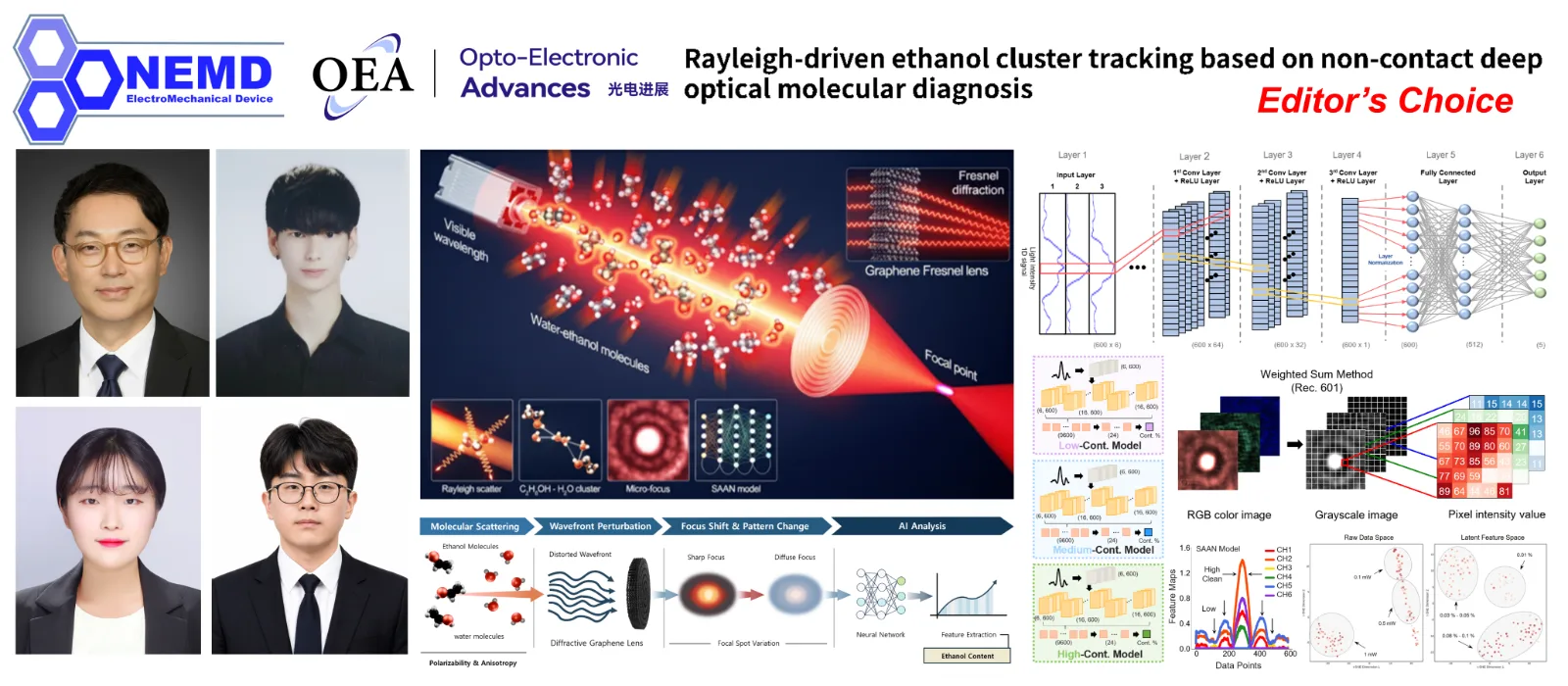
A research team led by Professor Jeon Seong-chan of the Department of Mechanical Engineering (first authors Kim Geon-mo and Hwang Yun-ji, integrated degree program students; co-author Hwang Tae-jong, integrated degree program student) has developed a non-contact ethanol molecular sensing technology utilizing multilayer graphene Fresnel lenses and deep learning. Existing ethanol detection technologies have primarily relied on precision analytical equipment, such as gas chromatography, or electrochemical and semiconductor-based contact sensors; however, these methods have limitations, including bulky equipment, long analysis times, and the potential for sensor materials to degrade due to repeated chemical reactions. The research team focused on the extremely weak Rayleigh scattering effect that occurs when ethanol molecules interact with laser light and proposed a method that analyzes changes in the focus of the main laser beam—which is slightly distorted by the scattering—rather than directly measuring the scattered light. To achieve this, the team used a Fresnel lens fabricated from five layers of graphene to focus light via diffraction and extracted the changes in the intensity, width, and shape of the focal spot—which vary with ethanol concentration—as an optical fingerprint. Furthermore, by applying the Self-Aware Assembly Network (SAAN) deep learning model—developed in-house—we implemented an integrated system capable of non-contact detection of ethanol concentrations in the range of 0.01%–0.1%. Since this technology enables the optical analysis of ethanol molecular information without requiring separate chemical reactions or direct contact with sensor materials, it presents potential for future applications such as non-invasive alcohol testing, breath-based disease diagnosis, and hazardous gas monitoring in industrial settings. The results of this study were published in *Opto-Electronic Advances* (IF: 22.4, top 4.3% in JCR) and were selected as Editor’s Choice.
Link to the paper: https://www.oejournal.org/oea/article/doi/10.29026/oea.2026.250278