


News
Preclinical development of engineered biomaterial-based artificial bladder demonstrating core functions in a large-animal orthotopic model
- Date
- Category
- Achievement
Preclinical development of engineered biomaterial-based artificial bladder demonstrating core functions in a large-animal orthotopic model
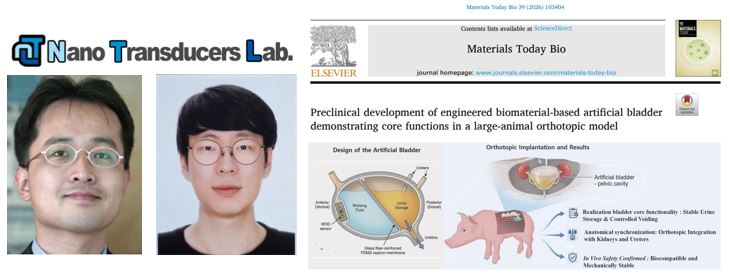
The research team led by Prof. Jongbaeg Kim in the Department of Mechanical Engineering and Prof. Won-Gun Koh in the Department of Chemical and Biomolecular Engineering at Yonsei University, in collaboration with the College of Medicine at The Catholic University of Korea, developed a biomaterial-based implantable artificial bladder that integrates urine storage, bladder fullness sensing, and controlled voiding within a single system. Conventional bladder reconstruction primarily relies on intestinal segments or tissue-engineered substitutes, but these approaches have limitations in reproducing the integrated storage, sensing, and voiding functions of the native bladder. To address these limitations, the research team developed a biocompatible polymer-based artificial bladder in which a flexible septum separates the urine-storage and working-fluid compartments. The flexible deformation of the septum enables low-pressure urine storage, while a manually operated pump transfers the working fluid to generate the pressure required for voiding. In addition, a wireless, battery-free RFID sensor was incorporated to enable external detection when the bladder reaches a predefined fullness level. The developed artificial bladder was implanted orthotopically in a mini-pig model and evaluated for six weeks. The implanted device maintained stable connections with the ureters and urethra as well as structural integrity, while urodynamic evaluation demonstrated a storage capacity of 95 mL and a voiding efficiency of 94%. Through this interdisciplinary collaboration between engineering and medicine, the study integrated biomaterials, fluid-pressure control, and wireless sensing technologies to implement the key functions of the bladder within a single implantable system and demonstrated the feasibility of its storage and voiding functions in a large-animal model. The research was published in the international biomaterials journal Materials Today Bio.
The link: https://www.sciencedirect.com/science/article/pii/S2590006426006496?via%3Dihub