

-
138
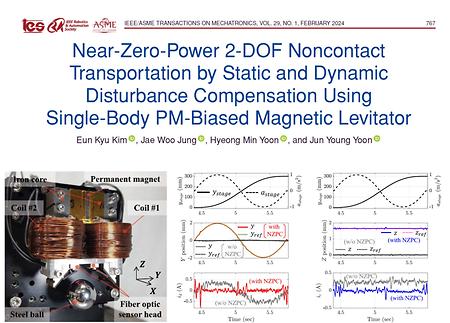
- Near-zero-power Control Method for High-throughput Non-contact Transportation Utilizing 2-DOF PM-biased Magnetic Levitat
- Near-zero-power Control Method for High-throughput Non-contact Transportation Utilizing 2-DOF PM-biased Magnetic Levitator The research team, led by Professor Jun Young Yoon from the Department of Mechanical Engineering (first author of this study is Eun Kyu Kim), has studied near-zero-power control method of the 2-DOF magnetic levitator during high-throughput non-contact transportation. It has been demonstrated that the proposed 2-DOF permanent-magnet-biased magnetic actuator can be utilized to reject the static and dynamic disturbance without nominal current consumption during non-contact transportaion, showing a significant potential for industrial applications where high-throughput transportation tasks are required in a non-contact manner. This research has been published in the renowned international academic journal 'IEEE/ASME Transactions on Mechatronics' in Feburary 2024. The link: https://ieeexplore.ieee.org/abstract/document/10179114
- 기계공학부 2024.03.20
-
137
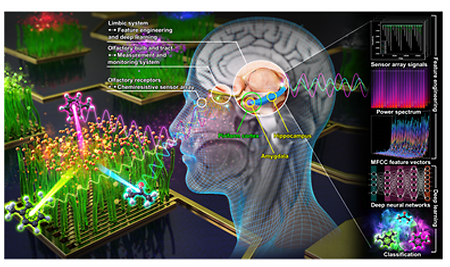
- Data-centric artificial olfactory system based on the eigengraph
- Data-centric artificial olfactory system based on the eigengraph The research team of Professor Seong Chan Jun of the Department of Mechanical Engineering (first author, Master Seung-Hyun Sung, contributing author Yun Ji Hwang), the research team of Professor Ho Won Jang of the Department of Materials Science and Engineering at Seoul National University (co-first author, PhD Jun Min Suh), and Jeon Gue Park, CEO of Tutorus Labs Inc. have conducted joint research on the topic of 'Data-centric artificial olfactory system based on the eigengraph'. In this paper, they developed and integrated sensor arrays, electrochemical measurement devices and artificial intelligence algorithms that correspond to the functions of the olfactory receptors and each region of the brain responsible for the human olfactory mechanism to implement a data-centric artificial olfactory system and its standard model was presented. The law of existence of the eigengraph in electrochemistry was proven and declared for the first time in the world by capturing the unique electrochemical reaction that naturally exists between sensing materials and gas molecules. Based on the waveform analysis principle for eigengraphs, they have shown that various types and mixed states of gas molecules can be identified with nearly 100% accuracy even in all weather and unknown environments by extracting odor characteristics necessary for the identification of gas molecules through mathematical algorithms. They explained that this is the result of overcoming the limitations of existing sensitivity-dependent artificial olfactory technology that is vulnerable to external environmental changes. This technology can be applied and used in a wide range of fields, including artificial intelligence robots, space exploration, home appliance industry, defense industry, and forensic investigation. This study was published in a world-renowned international academic journal 'Nature Communications' (Impact Factor: 17.694). The link: doi.org/10.1038/s41467-024-45430-9
- 기계공학부 2024.03.20
-
136
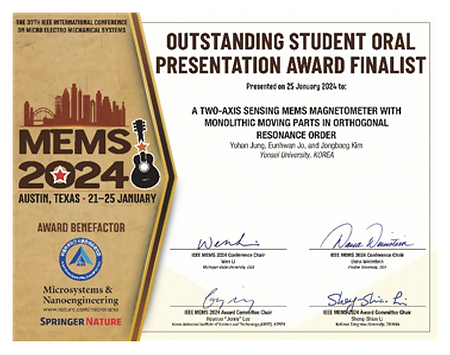
- Development of Two-Axis MEMS Magnetic Field Sensor Using an Eccentric Resonator
- Development of Two-Axis MEMS Magnetic Field Sensor Using an Eccentric Resonator Professor Jongbaeg Kim's research team has successfully developed a two-axis MEMS magnetic field sensor using an electromagentic inductor and an eccentric resonator driven by electrostatic forces. This approach allowed for the realization of a resonator that resonates in orthogonal directions by altering the sensor's operating frequency, thereby experimentally validating the capability for two-axis magnetic field detection. This work was presented at the 2024 37th IEEE MEMS Conference organized by the Institute of Electrical and Electronics Engineers (IEEE), highlighting its significance within the community. Additionally, the research earned distinction as a finalist for the Outstanding Student Oral Presentation Award, an accolade bestowed upon only 19 of the 659 papers submitted, acknowledging its excellence and contribution to the field. The link: https://ieeexplore.ieee.org/document/10439558
- 기계공학부 2024.03.20
-
135
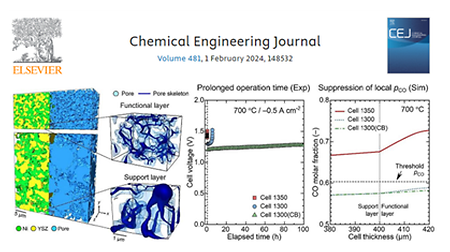
- Microstructural Improvement of High-Temperature Solid Oxide Electrolysis Cells for High-Efficiency and High-Stability Ca
- Microstructural Improvement of High-Temperature Solid Oxide Electrolysis Cells for High-Efficiency and High-Stability Carbon Dioxide Electrolysis The research team, led by Professor Jongsup Hong from the Department of Mechanical Engineering (co-first author is Wooseok Lee) collaborated with Dr. Yoon Kyung-joong's team from KIST and Professor Lee Kang-taek's team from KAIST to improve the stability of solid oxide electrolysis cells (SOEC) that convert greenhouse gas carbon dioxide into high-value fuels. They solved the problem of carbon deposition caused by poor gas diffusion through improvement of the microstructure of the fuel electrode and elucidated the stability improvement mechanism based on FIB-SEM analysis and multi-physics computational analysis. This research has been published in Chemical Engineering Journal, a top-tier journal in the fields of thermal and reaction engineering (as of 2022, with an impact factor of 15.1, ranking in the top 3.2% in the JCR Engineering, Chemical section), recognizing its qualitative excellence. The link: https://doi.org/10.1016/j.cej.2024.148532
- 기계공학부 2024.03.20
-
134
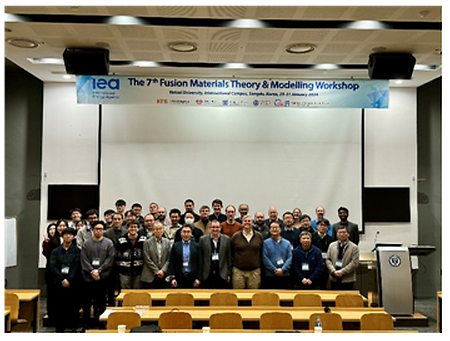
- Hosting an international nuclear materials theory and modeling workshop (2024.01.29 ~ 2024.01.31)
- Hosting an international nuclear materials theory and modeling workshop Professor Keonwook Kang from the Department of Mechanical Engineering, in collaboration with the Korea Fusion Energy Research Institute, Kyunghee University, and Seoul National University, hosted 'The 7th Fusion Materials Theory & Modeling' workshop at the International Campus of Yonsei University from January 29 to 31, 2024. The event is a series of workshops hosted by the Fusion Materials Technology Cooperation Program (FM TCP), organized under the support of the International Energy Agency (IEA), to present and discuss the latest scientific results in nuclear materials theory and modeling. In this workshop, 30 oral speeches were presented in five different topics (▲Optimized modelling and experimental validation, ▲ Materials response theory, ▲Transmutation impacts, ▲ Machine learning for material simulations and design, and ▲ General topics in fusion materials), covering the latest theory & modelling about material design in nuclear fusion reactors were introduced and discussed. The link: https://ukaeaevents.com/7th-fusion-materials-theory-modeling-workshop/
- 기계공학부 2024.03.20
-
133
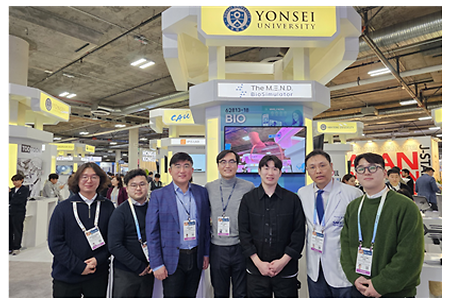
- Laboratory startup, The M.E.N.D. BioSimulator Inc. particpated in ‘CES 2024’
- Laboratory startup, The M.E.N.D. BioSimulator Inc. particpated in ‘CES 2024’ The research team led by Professor Joon Sang Lee from the Department of Mechanical Engineering showcased their healthcare products from their lab startup(The M.E.N.D. BioSimulator Inc.) at CES 2024 held in Las Vegas, USA, in January 2024. This event is the largest consumer electronics show in the world. They exhibited a total of five products including CARDIOS, an AI-based cardiovascular risk automatic prediction diagnostic device; MIASfacial, a system for predicting the quantity of facial asymmetry and filler injections; and N-UDS, a non-invasive urodynamic testing system. The exhibition attracted significant attention from attendees. Moreover, the team achieved meaningful results, such as proposals for collaboration with American investors, consulting for the establishment of a Japanese corporation, and agreements for joint research and investment from the US medical community.
- 기계공학부 2024.03.20
-
132
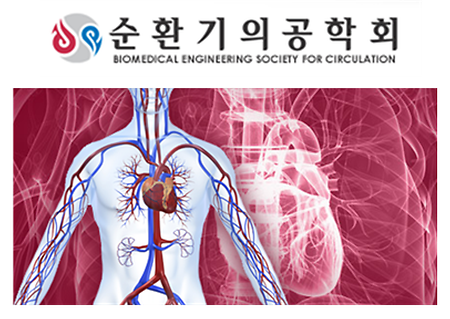
- Professor Joon Sang Lee was inaugurated as the 12th president of the Biomedical Engineering Society for Circulation
- Professor Joon Sang Lee was inaugurated as the 12th president of the Biomedical Engineering Society for Circulation Professor Joon Sang Lee from the Department of Mechanical Engineering was inaugurated as the 12th president of the Biomedical Engineering Society for Circulation in January 2024. This society, established in 2001, aims to promote interdisciplinary research and exchange activities between medicine and engineering related to cardiovascular diseases. It has conducted joint symposiums, academic conferences, and workshops in medicine and engineering to identify and address unmet needs in clinical settings. Additionally, to facilitate the commercialization of related technologies, the society secured a engineering research center (ERC) in 2022 and is currently conducting research centered around this institution.
- 기계공학부 2024.03.20
-
131
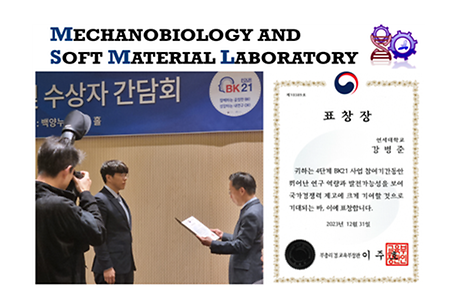
- Award for outstanding young researchers in Brain Korea 21 Project by the Minister of Education of Republic of Korea
- Award for outstanding young researchers in Brain Korea 21 Project by the Minister of Education of Republic of Korea Dr. Byungjun Kang, who is working in Prof. Hyungsuk Lee’s laboratory, was chosen as one of the 29 'Outstanding Participants' in the 4th phase of the 2023 BK21 Project in recognition of his outstanding research accomplishments. As a result, he was honored with the Minister of Education Award on December 31, 2023. The certificate for this accolade was presented to Dr. Kang by Professor Dong-Hyun Kim, who serves as the Director of the Graduate School Planning Division at Yonsei University, on January 10, 2024. This year, a total of three researchers from Yonsei University received this prestigious award.
- 기계공학부 2024.01.29
-
130
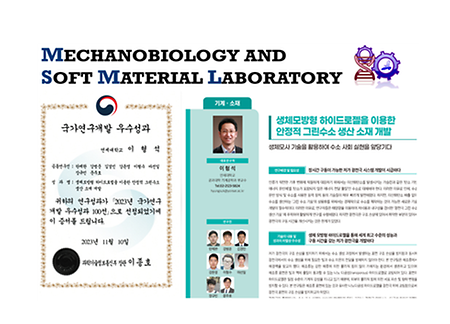
- Award by the Minister of Science, Technology, and Information and Communications in recognition of their inclusion in th
- Award by the Minister of Science, Technology, and Information and Communications in recognition of their inclusion in the 2023 National Research and Development Excellence 100 The research achievement of Professor Hyungsuk Lee in our education research center, titled 'Development of Stable Green Hydrogen Production Materials Using Biomimetic Hydrogels,' was selected for the 2023 National Research and Development Excellence 100 and featured in a related casebook published by the government. In recognition of this achievement, Professor Hyungsuk Lee received the award by the Minister of Science, Technology, and Information and Communications on November 10, 2023. The research achievement, selected for the Excellence 100, was published in the world-renowned journal Nature Energy (impact factor: 56.7 according to JCR 2022), with the title 'Hydrogel protection strategy to stabilize water-splitting photoelectrodes,' in June 2022 (based on an impact factor of 56.7 as of 2022).
- 기계공학부 2024.01.29
-
129
- Dr. Eunhwan Jo is appointed as an assistant professor at Kumoh National Institute of Technology (2024.01.01)
- Dr. Eunhwan Jo is appointed as an assistant professor at Kumoh National Institute of Technology Dr. Eunhwan Jo was appointed as a professor in the Department of Mechanical Engineering at Kumoh National Institute of Technology in January 2024. He earned his doctoral degree in the laboratory of Professor Jongbaeg Kim of the Department of Mechanical Engineering and served as a postdoctoral researcher and research professor in the same laboratory, Since receiving his Ph.D., Dr. Eunhwan Jo has published numerous high-quality international journal papers, including ACS Nano, Microsystems & Nanoengineering, and ACS Applied Materials & Interfaces, while working at Yonsei University.
- 기계공학부 2024.01.19